 Karaknetwork
 used multiasset vaults to back operator-run security services
Karaknetwork is the Karak project, whose legacy restaking system connected deposited assets with operators securing Distributed Secure Services. Its design supported several asset types, including liquid staking tokens and stablecoins. V1 and V2 used different contract paths, while native restaking had a separate vault implementation. Karak later rebranded to OpenGDP. The legacy interfaces include V1 Staking, V2 Staking and K2 Bridge, with withdrawal conditions specific to each position and contract version.
Legacy Karak withdrawals depend on the contract and vault type; the documented V2 default ERC20 vault used a nine-day delay.
Vault selection tied deposits to an operator
In the V2 restaking design, a deposit into a particular vault delegated assets to its assigned operator. Each asset an operator accepted had a separate vault, so asset selection and operator selection described different parts of the position. The vault held collateral; the operator undertook work for services using that collateral as economic security. Multiasset support included liquid staking tokens and stablecoins, with acceptance specific to each vault and deployment. The legacy V2 interface includes Arbitrum and separate fields for asset, operator and deposit amount.
V1 and V2 used different contract paths
V1 organized token deposits around VaultSupervisor, a contract coordinating individual asset vaults. DelegationSupervisor handled queued withdrawals through startWithdraw and finishWithdraw. Its withdrawalDelay function exposed the waiting period applicable to that contract.
V2's default ERC20 vault accepted deposits directly and exposed its own asynchronous redemption functions. Core coordinated operators, service registration and vault deployment. Both versions involved deposited assets and shares, but their withdrawal requests belonged to different contracts. A V1 withdrawal root and a V2 withdrawal key therefore identified requests within their respective versions.
Shares and liquid restaking tokens recorded different claims
The default V2 vault issued shares representing a depositor's claim on its underlying assets. Its ERC4626-based accounting distinguished asset amounts from share amounts. Conversion functions mapped one quantity to the other, so identical numerical balances did not necessarily describe identical units. A share balance recorded ownership in the vault, rather than a fixed quantity of underlying tokens.
A liquid restaking token, or LRT, could sit above those operator vaults. In the documented wrapper design, a separate vault accepted deposits and issued receipt tokens. Its administrator allocated the underlying assets among operator vaults and handled rebalancing or withdrawals. This added an allocation layer between the receipt holder and the restaking positions. The wrapper also needed a withdrawal queue to accommodate Karak's delayed redemptions.
Distributed Secure Services supplied the security task
A Distributed Secure Service, abbreviated DSS, used restaked collateral as economic backing for work performed by operators. Registering with a service meant undertaking its required computation and returning results. The service defined the relevant performance expectations. Failure to satisfy those expectations could lead to a request to slash part of the associated collateral.
Operators could allocate the same vault to multiple services. This reuse connected one collateral pool to several sets of obligations, without creating additional underlying assets. The documented architecture included service registration and vault-allocation controls within Core. A deposited balance, an operator's service registration and a vault's allocation described related but distinct parts of the security arrangement.
NativeVault handled validator-backed restaking
Native restaking used NativeVault, a specialized implementation connected to Ethereum validator balances. In the July 2024 implementation, NativeVault validated that validator withdrawal credentials pointed to the participant's NativeNode. Balance proofs and snapshots connected validator activity to the vault's internal accounting. This required different machinery from transferring an ERC20 token into the default vault.
A snapshot completed when the contract processed balance proofs for all active validators associated with the node. Balance changes could increase or decrease the participant's shares. The implementation distinguished total restaked ETH from ETH credited for withdrawal through the node. Native withdrawal requests also required a sufficiently recent snapshot and completion remained subject to a delay.
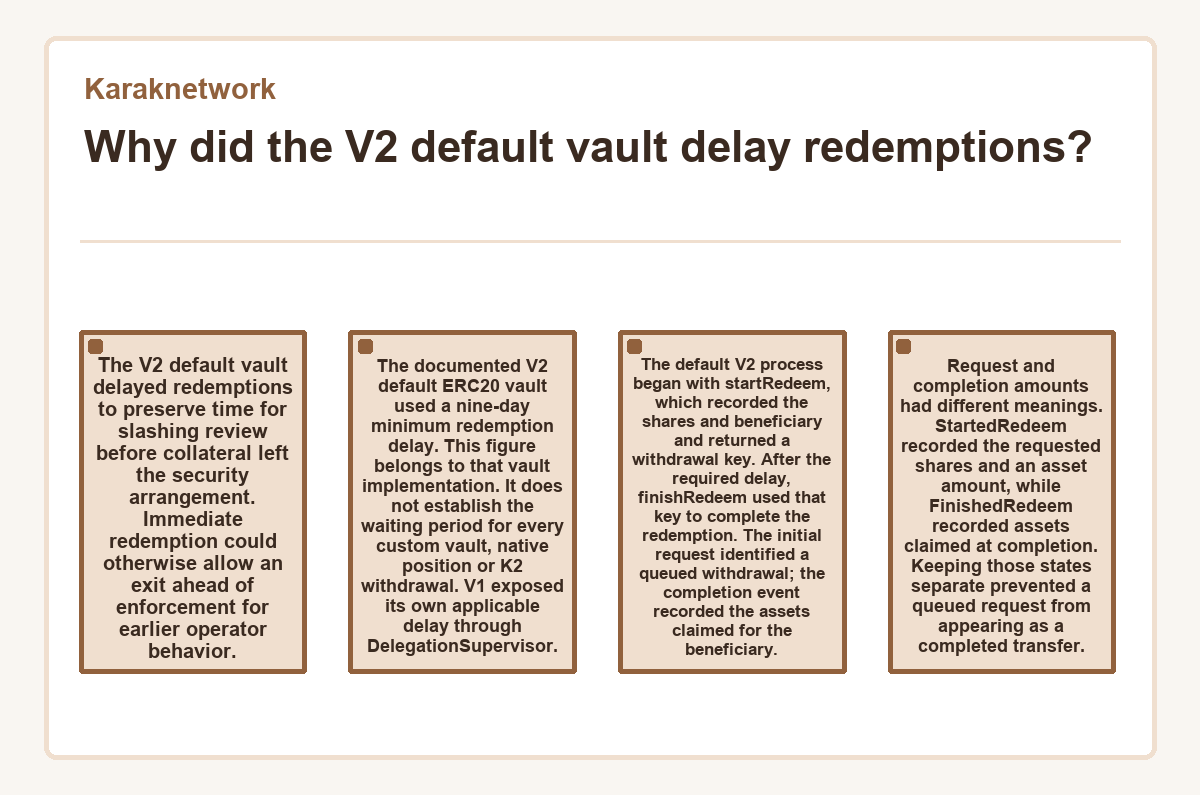
Why did the V2 default vault delay redemptions?
The V2 default vault delayed redemptions to preserve time for slashing review before collateral left the security arrangement. Immediate redemption could otherwise allow an exit ahead of enforcement for earlier operator behavior.
The documented V2 default ERC20 vault used a nine-day minimum redemption delay. This figure belongs to that vault implementation. It does not establish the waiting period for every custom vault, native position or K2 withdrawal. V1 exposed its own applicable delay through DelegationSupervisor.
The default V2 process began with startRedeem, which recorded the shares and beneficiary and returned a withdrawal key. After the required delay, finishRedeem used that key to complete the redemption. The initial request identified a queued withdrawal; the completion event recorded the assets claimed for the beneficiary.
Request and completion amounts had different meanings. StartedRedeem recorded the requested shares and an asset amount, while FinishedRedeem recorded assets claimed at completion. Keeping those states separate prevented a queued request from appearing as a completed transfer.
Core handled slashing requests while services distributed rewards
A DSS could request slashing through Core when an operator breached its obligations. The documented review process gave the veto committee two days to consider the request before finalization. The committee could cancel a request. Slashing therefore involved an enforcement request and a review window, rather than an immediate deduction whenever a service reported a problem.
Service rewards followed a separate distribution arrangement. The DSS handled rewards outside the core vault accounting, and an LRT integration needed a way to claim them from the service or operator. Depositing into a vault did not, by itself, specify a payout rate, reward asset or distribution schedule.
Karak XP tracked participation through a separate program. Its variable accrual rules did not replace service-specific reward distribution.
A vault position and a K2 claim had separate exit paths
For a hypothetical wallet holding a V2 default-vault position and an eligible K2 withdrawal, the two balances represent different claims. The vault position belongs to an operator-linked restaking arrangement. Its shares enter the vault's delayed redemption process. The K2 Claims interface instead addresses available K2 assets associated with a wallet's withdrawals.
K2 claim eligibility does not establish whether the vault's redemption delay has elapsed. Likewise, a vault withdrawal key does not establish eligibility for a K2 claim.
K2 and Karak Network Stack extended shared security
K2 was Karak's Layer 2 environment, built using the OP Stack. Its development role included experimentation with Distributed Secure Services and custom precompiles. A network environment supplied infrastructure for service development, while operator vaults supplied collateral for the restaking arrangement. Those components occupied different layers of the architecture.
The Karak Network Stack, or KNS, broadened the project toward customizable blockchain networks using shared security and validator sets. That direction included specialized networks for financial markets and other applications. It described network-building infrastructure, beyond the deposit and redemption functions of an individual restaking vault.
Developer tooling connected services with stake data
The Karak SDK supported building vaults and Distributed Secure Services. Its documented components covered offchain interaction with Core, key management and peer-to-peer communication, alongside onchain service building blocks. This tooling addressed how an operator and service coordinated their work around the contracts holding restaked assets.
For stake accounting, Core exposed the vaults an operator had allocated to a particular DSS. Each vault exposed its underlying asset amount through totalAssets. A service could therefore identify its operator-linked vaults and their collateral balances without treating an operator's entire portfolio as backing every service. Different token balances still required a common valuation basis before meaningful aggregation.
What changed when Karak became OpenGDP?
Karak announced its rebrand to OpenGDP on November 16, 2025, retaining the same team and codebase lineage. The transition changed the brand and product direction while preserving compatibility for existing users at that time.
The current landing screen presents an Open World Model Network as coming soon and groups the Karak staking interfaces under Legacy. The legacy V2 screen continues to display Deposit and Unstake controls. The K2 interface presents claims for available withdrawal assets.
Legacy labeling alone does not establish a universal exit deadline or complete shutdown. The retained entry points are V1 Staking, V2 Staking and K2 Bridge.
Karaknetwork - your questions answered
Can a Karaknetwork V1 position migrate to every V2 network?
No. The documented migration path required V2 to enable the position's asset and network. The owner also had to approve the vault route, and both vaults had to manage the same underlying asset. The V2 Portfolio interface showed the migration option for eligible combinations. Rolling migration plans did not make every combination immediately available. An absent migration control therefore did not, by itself, establish that the V1 position had already moved or that its asset could never migrate.
What does minSharesOut protect during a V2 deposit?
The default V2 vault's minSharesOut parameter made the deposit revert if it minted fewer shares than the specified minimum. The protected deposit overload included this bound alongside the asset amount and recipient. A simpler overload omitted it. This protection addressed unfavorable share output during deposit execution; it did not remove operator slashing exposure or shorten the redemption delay.
Which Karak version supported referral-based XP?
Referral-based XP belonged to V1. The V2 mainnet design omitted invite codes and referrals, so referrals did not earn XP there. This version difference concerned referral rewards, separately from XP associated with restaking participation.
Does approving a vault transfer assets immediately?
Token approval authorizes the vault to transfer tokens within the allowance, while the deposit performs the transfer into the vault. The documented default ERC20-vault integration treated these as separate operations. Approval alone therefore does not establish a deposited position or a minted share balance.
Where can I read a pending V2 redemption's start time?
The standard V2 vault's getQueuedWithdrawal function returned the request's start time, staker, share amount and beneficiary. It took the staker address and withdrawal nonce. The timestamp belonged to that particular request; the deposit time and a K2 claim record did not substitute for it.
Are Karak XP points a fixed token allocation?
XP points alone did not specify a token amount. The program rewarded restaking participation and allowed XP accrual rates to change. Any token allocation would require separate eligibility and conversion terms. The November 2025 rebrand addressed future token updates separately and did not turn historical XP balances into a fixed token entitlement.
How did services compare stakes held in different assets?
KarakStakeViewer converted active vault balances into US dollar (USD) values using configured asset-price oracles. Its documented implementation supported Chainlink oracles and required the owner to configure each asset's oracle data. The calculation excluded vaults queued for unstaking and tokens queued for withdrawal. This provided a common valuation basis without treating a token count as a dollar balance.
Would a custom vault need permission before deployment?
A custom vault needed its asset and implementation allowlisted in Core before deployment. The implementation also needed to follow IKarakBaseVault so Core could manage it. Using the existing default vault avoided the separate custom-implementation approval, while asset allowlisting still applied. A compatible interface alone did not establish permission to deploy a new asset vault.
Updated -