 Karaknetwork
 legacy V2 token deposits required approved assets for the selected operator vault
Karaknetwork first deposits in the documented V2 restaking design used approved assets to create shares in an operator vault. The protocol approved collateral through an asset-specific slashing handler, while each operator accepted assets through separate vaults. A token balance alone therefore did not establish deposit readiness. Karak rebranded to OpenGDP in November 2025, and the staking interfaces now appear as legacy entries. Any new deposit requires a compatible vault and an available entry function in the selected deployment.
The legacy V2 design required an enabled deposit function as well as an approved asset matching the operator vault.
Asset approval joined vaults to slashing handlers
Each accepted asset needed a protocol-approved slashing handler before an operator could deploy a compatible vault through Core, connecting deposit collateral with the mechanism handling penalties.
Protocol asset approval
In the July 2024 design, the protocol's Core contract stored a mapping between asset contracts and slashing handlers. Its vault configuration check rejected an asset without a handler in that mapping. The asset contract identified the collateral; approval concerned this specific token identity. An operator could choose which approved assets to accept, so protocol approval and the operator's offering answered separate questions about a proposed deposit.
Implementation approval
Core's deployment path also limited which vault implementations operators could use. Core accepted its designated standard implementation or an implementation on the approved list. The protocol owner controlled approval of custom implementations. This additional control concerned the vault's behavior, including how it handled collateral. Asset approval alone did not authorize every implementation, and implementation approval alone did not admit every asset.
Chain and operator selections identified the destination
The legacy V2 interface lists Arbitrum in its chain selector and separates asset, operator and deposit amount into distinct fields. The chain identifies the deployment context, while the operator identifies the party associated with the vault. Each asset an operator accepted had a separate vault, so choosing an operator did not create one destination for every wallet holding. The vault's configured asset had to match the intended collateral on the selected chain. A displayed chain choice does not establish identical support or function availability across other deployments.
Shares recorded the claim created by a deposit
In the July 2024 restaking design, vault shares represented ownership of the corresponding deposited assets. Stakers received shares based on their deposit relative to the vault's assets. The shares recorded a claim within that vault, while the underlying asset remained the collateral backing the position. Asset quantities and share quantities consequently described different things; the design did not promise a universal one-to-one conversion.
The operator managed service commitments, while the shareholder held the asset claim. Slashing could reduce collateral behind the shares, so share ownership alone did not promise an unchanged redemption value. The operator's service exposure mattered alongside the identity of the asset entering the vault.
The selected entry function set deposit readiness
Standard token vaults
The July 2024 standard Vault implementation accepted nonzero asset amounts through deposit. It also exposed mint for a specified share amount. A first deposit needed an enabled method supported by the actual vault and interface. The caller needed sufficient underlying tokens and a spending allowance for the vault, separate from protocol asset approval. A deposit call specified the asset amount and share recipient. The minSharesOut overload reverted with NotEnoughShares if minted shares fell below the caller's chosen minimum; the ordinary deposit lacked that check. Custom implementations could have different entry requirements.
Function availability
Core could pause and unpause the standard vault's functions. An enabled entry function was therefore a separate prerequisite from matching the approved asset. The legacy application's Deposit button identifies an action, but its presence does not establish the execution state of every vault. The historical approval rules describe compatible configurations; availability of a new deposit remains specific to the selected legacy deployment.
What confirms a first deposit created a position?
A first deposit established a vault position when the intended recipient received a positive share amount in the selected vault. In the standard token vault, a successful deposit transaction's Deposit event recorded the caller, recipient, asset amount and minted shares. An amount entered into a deposit form described the proposed input, without establishing how many shares the recipient received.
The standard deposit function named an address to receive the minted shares, so the initiating wallet and the intended shareholder were not necessarily identical. A later service reward distribution or an unrelated withdrawal claim represented a different event from creation of these shares.
An approved asset could mismatch the selected vault
Protocol approval could not make a token compatible with a vault configured for a different underlying asset. In this hypothetical first session with a legacy V2 token vault, the wallet holds a protocol-approved asset, while the reader has selected a standard operator vault configured for another asset. The reader wants to understand whether approval makes this pairing ready for a deposit.
The slashing-handler mapping explains the holding's protocol approval. The asset stored in the vault configuration explains what that particular vault accepts. The holding satisfies the first relationship and fails the second. Changing the proposed amount would leave the asset mismatch unchanged, because the destination still expects a different token.
The reader leaves the deposit unsubmitted, keeping the assets outside the operator vault.
A vault configured for the held asset would resolve the mismatch if the operator offered one. Its relevant entry function would also need to remain enabled before this revised pairing could support a deposit.
Service allocation extended the position beyond the vault
An operator could commit a vault's stake to Distributed Secure Services (DSSs), which coordinated tasks and used the collateral as economic security. Deposited assets could back the operator's service commitments when the vault had an applicable allocation. The asset supplied collateral, the vault recorded ownership and the operator performed service work. Service allocation supplied the restaking use for that collateral; the deposit itself recorded the staker's vault position.
In the July 2024 design, an operator could stake the same vault with multiple services. Each selected service received the vault's full stake commitment, so the model allowed overlapping exposure. A deposit did not necessarily correspond to a single security task. Unallocating a vault from a service also carried a documented waiting period. Each service's rules governed its tasks and penalties.
Rewards and withdrawal commitments followed different rules
Service reward accounting
Service rewards followed DSS rules, and the July 2024 design kept their distribution outside the core contracts.
Rewards sent directly to an operator vault could create front-running opportunities. Service rewards could also use a token different from the deposited collateral. An off-chain indexer could calculate entitlement, with a Merkle distribution delivering rewards separately. Initial share issuance therefore did not record a reward payment. The design also instructed services to stop counting assets for rewards and voting weight when a staker initiated withdrawal.
The withdrawal window
The July 2024 restaking design specified a minimum staker withdrawal delay of 9 days. The waiting period gave services time to address misconduct occurring before withdrawal initiation. Asset approval and share creation therefore did not provide immediate access to deposited collateral.
That historical parameter does not determine every legacy exit. V1 positions, custom vault implementations and K2 withdrawal claims require their applicable contract rules. For a proposed first deposit, the relevant commitment is the selected position's own exit path. The interface's Unstake label alone does not establish its withdrawal delay.
Native restaking and K2 claims had separate prerequisites
NativeVault verified that validator withdrawal credentials pointed to an owner's NativeNode and used snapshot proofs to update balances in the July 2024 implementation. It disabled the ordinary deposit and mint entry points. Native restaking therefore required its own node and validator relationships; an approved token and a standard deposit form did not supply those prerequisites. The implementation completed snapshots only after proofs covered all active validators of the node.
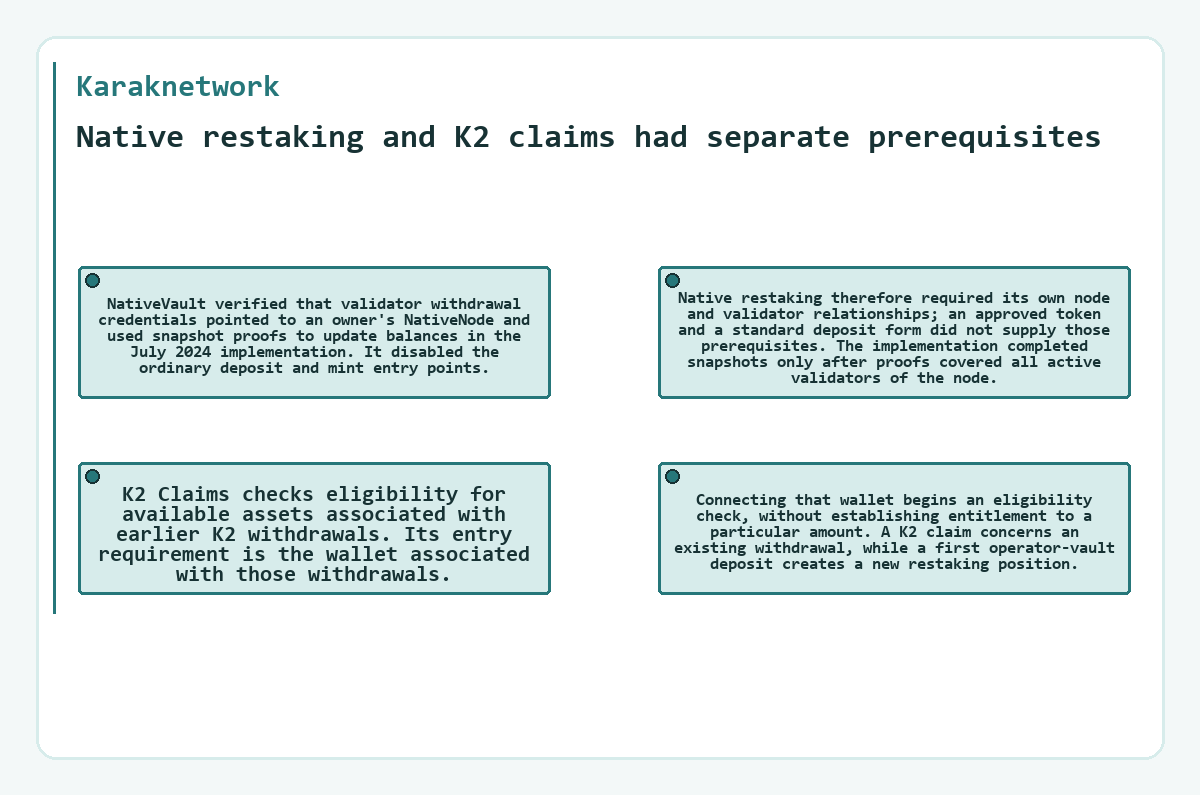
K2 Claims checks eligibility for available assets associated with earlier K2 withdrawals. Its entry requirement is the wallet associated with those withdrawals. Connecting that wallet begins an eligibility check, without establishing entitlement to a particular amount. A K2 claim concerns an existing withdrawal, while a first operator-vault deposit creates a new restaking position.
Legacy entry choices remained distinct after the rebrand
Karak rebranded to OpenGDP on November 16, 2025, with existing user behavior unchanged that day apart from the brand and URLs. The legacy menu now includes V1 Staking, V2 Staking and K2 Bridge. These separate entries preserve the distinction between versions and withdrawal contexts. The new name does not turn the July 2024 contract design into a universal rule for every legacy action.
A proposed first deposit needs an applicable asset, operator vault and enabled entry method under the selected version. An existing position instead brings its own share ownership and exit conditions. Leaving assets in the wallet keeps them outside the operator vault's service commitments; depositing adds the operator-linked exposure and the applicable withdrawal requirements.
Key questions about Karaknetwork
What happens if a standard Karaknetwork vault deposit specifies zero assets?
The July 2024 standard Vault rejected zero-amount deposits with ZeroAmount. The check applied to its ordinary deposit function and the minSharesOut overload. It did not set a universal monetary minimum across assets or other implementations.
Does my first deposit oblige a service to accept the operator?
A first deposit did not compel a Distributed Secure Service to accept its operator. The July 2024 design allowed a service's allocation hook to reject an allocation and revert that allocation transaction. This decision concerned participation in the service, separate from the asset approval and vault configuration permitting the deposit.
Which balance counted when NativeVault first added a validator?
The July 2024 NativeVault design used the validator's effective balance when adding the validator and minting shares. It disregarded excess balance in the balance container at that point. A subsequent snapshot could bring that excess into restaking accounting, so initial recognition and later balance updates described distinct stages of the native position.
Who could change the node implementation behind a native restaking position?
The July 2024 NativeVault gave the owner or a manager-role holder authority to change the NativeNode implementation, subject to that function's pause control. That authority covered upgrades of the nodes associated with the vault. It formed part of the position's administrative trust assumptions, distinct from the staker's asset claim or an operator's service duties.
How could a slashing handler treat the asset backing my first deposit?
The July 2024 design allowed asset-specific slashing handlers to process penalties differently. A handler could burn an asset, swap it for ETH before burning or distribute it to affected parties. The applicable handler determined the treatment; depositing an approved asset did not imply every asset used the same penalty mechanism.
Will a paused deposit overload always block the other deposit method?
The July 2024 standard Vault assigned separate pause flags to its ordinary deposit function and its minSharesOut overload. Pausing one method therefore did not inherently pause the other. The actual pause configuration governed each entry method. An enabled ordinary deposit did not provide the overload's minimum-share protection.
Are standard vault shares transferable after a first deposit?
The documented standard vault design allowed ERC-20 share transfers, while the July 2024 NativeVault rejected transfer and transferFrom. In the transferable design, the share owner held the corresponding asset claim. That distinction belonged to the implementation, so a standard token vault's transfer behavior did not establish the behavior of native restaking shares.
Updated -